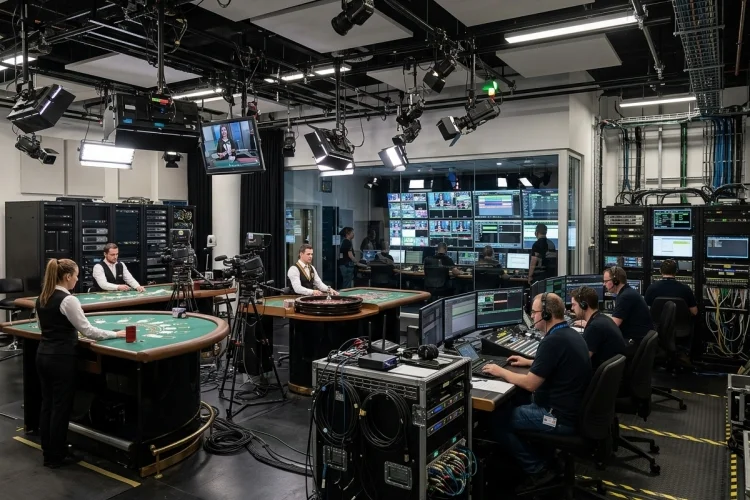
A live dealer table may appear straightforward on a phone or computer. The dealer distributes cards, spins a roulette wheel, or operates a game-show device while players place wagers through an online interface.
Behind that simple presentation is a complex production and gaming system.
A good studio must connect physical equipment, cameras, microphones, result-recognition technology, casino software, player accounts, and payment systems.
Every component must work at the correct time. Even a small synchronization error could make it unclear whether a wager was accepted before betting closed.
This technical perspective is essential when asking what makes a good live casino studio. High-quality video is only one part of the answer.
A professional facility also needs dependable data transmission, accurate result capture, secure infrastructure, extensive logging, trained technical employees, and recovery procedures for unexpected failures.
Independent laboratories may perform both remote testing and physicssessing technical systems as well as premises, staffing, and operational responsibilities.
Multi-Angle Camera Production
Live tables need camera coverage that shows every stage of the game. A blackjack table may use one angle for the dealer, another for the cards, and a wider view for the complete playing surface.
Roulette may require close-ups of the wheel and result area. Game-show products can use moving cameras, animated overlays, and wider production sets.
The number of cameras is less important than their placement and purpose. Players should be able to verify relevant physical actions without unnecessary cuts or blocked views.
Lighting must support both visibility and visual comfort. Excessive reflections can make cards difficult to read, while dark areas may hide equipment details. Production teams should regularly check focus, framing, exposure, and synchronization.
Low-Latency Streaming
Latency is the delay between an action inside the studio and its appearance on the player’s device. Some delay is unavoidable, but the provider must manage it carefully.
The betting timer, dealer announcements, and visible actions should form a logical sequence. The system must stop accepting wagers before the result can be observed or predicted.
Live providers also need adaptive streaming because players connect through different devices and internet speeds. A lower-resolution stream may be preferable to repeated buffering when essential game data remains readable.
Studios are increasingly built as specialized production facilities rather than ordinary casino rooms.describes dedicated live studio operations in Europe, the United States, and Latin America.
Accurate Optical and Sensor Technology
The digital interface must recognize what happens at the physical table. Providers may use optical character recognition, sensors, barcode systems, or dealer input to capture results.
In blackjack, card values need to appear accurately. In roulette, the winning number must be confirmed before wagers are settled. A game-show wheel may require sensors that identify the final segment.
GLI notes that live dealer testing includes technical ments, helping determine whether the physical game and online system communicate correctly.
The technology should also detect incomplete reads and send them for review instead of guessing. A good system prioritizes accurate confirmation over rapid but potentially incorrect settlement.
Secure Systems and Controlled Access
A live casino studio processes game records, betting data, video feeds, and operational information. These assets need protection against unauthorized access and manipulation.
Security controls should cover employee permissions, production networks, database access, equipment maintenance, software changes, and incident response. Sensitive areas such as control rooms and equipment storage should have restricted physical access.
ISO/IEC 27001 defines requirements for establishing and continually improving an information security management system. Iframework for managing risks involving data, systems, employees, and operational processes.
Certification does not guarantee that a system will never fail. However, structured security governance is a stronger sign than relying on informal procedures or marketing claims.
Redundancy and Failure Recovery
Professional studios prepare for technical failure. Backup internet connections, power protection, replacement cameras, spare microphones, and redundant servers can prevent a minor fault from closing multiple tables.
The system should preserve accepted bets when a device or stream fails. Transaction records must show whether a wager reached the server before the betting window closed.
Fair interruption rules are particularly important in live gaming because the physical round may continue after the customer loses accandards state that policies for interruptions must not systematically disadvantage players.
Recovery plans should define who stops the table, who confirms the last valid result, and how customers are informed about settlement.
Detailed Logging and Audit Trails
A good live casino system records more than the final result. It may retain timestamps, accepted wagers, dealer actions, equipment messages, video references, table events, and settlement data.
These records allow technical teams to investigate disputes or unusual activity. They can help determine whether an error came from the studio, player interface, casino tem.
UK regulatory standards require live dealer operations to be independently auditable. citling systems may also need records that support investigations into cheating or collusion.
Reliable records protect both players and operators. Without a usable audit trail, decisions may depend too heavily on incomplete screenshots or memories.
Independent Testing and Change Management
A studio should be evaluated before launch and after significant changes. A new camera system, recognition tool, betting interface, table layout, or software update can create unexpected problems.
GLI performs remote and on-site livering responsibility, staffing, premises, systems, technical performance, and synchronicity. The UK Gambling Commission udio audits where previous jurisdictional reviews do not sufficiently cover its standards.
Changes should be documented, tested, approved, and capable of being reversed when necessary. Updating a production system without proper controls can affect many active tables at once.
A Responsive Player Interface
Technical quality extends to the controls displayed on the player’s screen. Bet values, table limits, countdown timers, results, and account balances should remain readable.
The interface should confirm accepted wagers immediately. It should also prevent late submissions without creating ambiguity about whether money was deducted.
Mobile layouts need particular attention because small screens can hide important information. Players should still be able to open rules, review recent results, and reach account controls.
A strong interface does not overload users with unnecessary animations. Its main purpose is to communicate accurately and support deliberate decisions.
From a technical perspective, what makes a good live casino studio is dependable coordination between physical production and digital systems.
Clear camera work, low-latency streaming, accurate result recognition, secure infrastructure, redundancy, audit trails, independent testing, and responsive controls are all essential.
Players cannot inspect every server or studio procedure, but they can identify visible signs of quality. Results should match the physical action, streams should remain stable, and disputed rounds should have traceable records.
Use live casino products only through legal, regulated operators working with recognized providers.
Read interruption policies before playing, maintain a stable connection, and set spending and session limits regardless of how advanced the technology appears.