
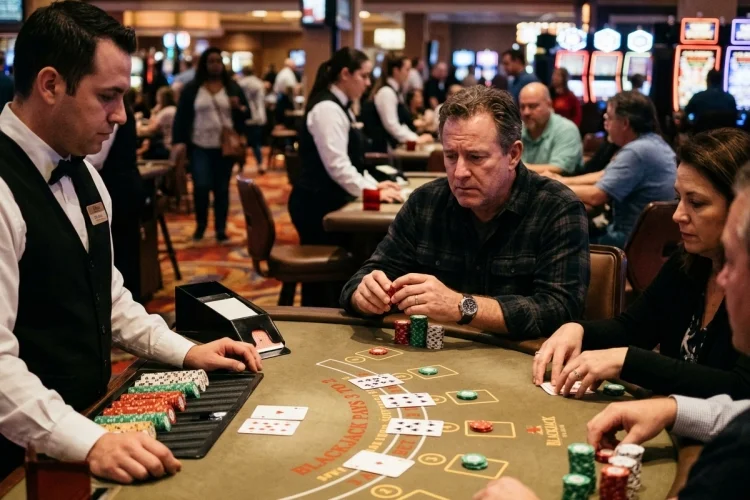
You can memorize perfect hit-and-stand strategy and still make expensive blackjack mistakes before the first card is dealt.
The table you choose, the payout for blackjack, optional side bets, and the way you manage your money can matter just as much as individual hand decisions.
Some Common Blackjack Mistakes happen because players focus entirely on the cards. They overlook rules that quietly increase the casino advantage or allow emotions to determine bet size.
Understanding the bigger picture can help you distinguish good decision-making from simply having a lucky run.
Choosing a 6:5 Table Without Checking the Payout
One of the easiest mistakes happens before you sit down.
Traditional blackjack commonly pays 3:2 on a natural blackjack, but some tables pay only 6:5.
The difference looks small until you calculate it.
A $10 blackjack pays $15 at 3:2 but only $12 at 6:5.
Wizard of Odds calculates that changing only the blackjack payout from 3:2 to 6:5 adds about 1.36 percentage points to the house edge in the example analysed, with all other rules unchanged.
Its example moves from approximately 0.46% house advantage to 1.82% simply because of that payout change.
That is why checking the blackjack payout should happen before worrying about fancy table features.
Assuming Fewer Decks Automatically Means a Better Game
Players often hear that single-deck blackjack is favourable and immediately choose any table advertising one deck.
The number of decks does influence blackjack mathematics, but it is not the only rule.
A single-deck table can compensate with poorer payouts or restrictive doubling rules. A multi-deck game can offer more player-friendly conditions in other areas.
Wizard of Odds’ house-edge calculator considers deck count together with dealer soft-17 rules, doubling restrictions, resplitting, surrender, blackjack payout, and other conditions.
The lesson is simple: compare the complete rules.
A large “SINGLE DECK” sign should not distract you from a small “Blackjack Pays 6 to 5” notice.
Using the Wrong Basic Strategy Chart
Basic strategy is not perfectly universal.
A chart designed for an eight-deck game where the dealer stands on soft 17 may contain a few different recommendations from one designed for single-deck blackjack where the dealer hits soft 17.
Rules such as double after split and surrender matter too.
Wizard of Odds provides different charts according to game conditions and explicitly separates dealer-hits-soft-17 from dealer-stands-soft-17 strategies.
Using a random screenshot saved years ago without checking the assumptions behind it can introduce small but repeated errors.
Before relying on a strategy chart, match it to the table.
It only takes a minute and makes the advice far more usefull.
Treating Insurance as Protection
Insurance is probably the best-named additional wager from a marketing perspective.
When the dealer shows an Ace, paying a little extra to “protect” your hand sounds sensible.
Mathematically, however, insurance is a separate wager that pays if the dealer has blackjack.
Standard basic-strategy guidance generally recommends declining it unless the player has additional information about the remaining deck composition. Wizard of Odds advises against both insurance and even money for ordinary basic-strategy players.
Taking insurance because you have a large original wager does not improve its underlying probability.
The size of the bet already on the table should not change the mathematics of the insurance proposition.
Automatically Adding Side Bets
Modern blackjack tables can include Perfect Pairs, 21+3, Bust bonuses, progressive jackpots, and many other optional wagers.
Their larger headline payouts make them attractive.
But they use mathematical structures different from the main blackjack game.
For example, Wizard of Odds calculates a 4.10% house edge for one common eight-deck Perfect Pairs paytable.
The 21+3 wager varies by paytable. Wizard of Odds shows examples ranging from a 3.24% house edge in one six-deck version to 13.39% in another six-deck version.
Those figures illustrate why a side bet should be evaluated seperately.
Playing blackjack basic strategy does not somehow make an optional poker-style side wager more favourable.
Read its paytable before treating it as part of your normal stake.
Increasing Bets Because You Are “Due”
A losing sequence can make the next hand feel unusually important.
You may think five losses in a row mean a win has to arrive soon, so doubling the wager appears logical.
But previous losing hands do not create a debt that the next hand must repay.
Betting systems that increase stakes after losses can rapidly increase the amount of money exposed without changing the underlying table rules.
For example, starting at $5 and repeatedly doubling after losses creates the sequence $5, $10, $20, $40, $80, and $160.
After only six consecutive losing bets, the total amount committed across the sequence is $315.
The table has not become more generous just because the bet size increased.
Confusing a Winning Decision With a Good Decision
Suppose you split tens and win both hands.
That result feels like proof that splitting was smart.
It is not.
One outcome cannot tell you whether a decision had the best expected value.
Likewise, you might follow basic strategy perfectly, double at the right time, receive a poor card, and lose.
The decision can still have been mathematically correct.
Blackjack strategy evaluates the full range of possible outcomes rather than judging each choice after the cards are revealed.
This is one of the hardest habits to develop because people naturally remember dramatic wins more strongly than routine mathematical decisions.
Judge the process before you know the outcome.
Betting Too Much to Double or Split Properly
Your initial wager is not always your maximum financial exposure for a blackjack round.
Imagine placing a $50 bet while carrying only enough bankroll for a few more $50 hands.
If you receive a pair that should be split, you may need another $50. If doubling is then appropriate on a resulting hand, another additional wager may be required.
Pagat explains that splitting normally requires an additional stake equal to the original wager, while doubling also typically adds a second equal wager.
Starting too large can therefore create a strange situation where your bankroll prevents you from following your intended strategy.
A smaller initial wager can leave more room for doubles and splits without exceeding the planned session budget.
Chasing Losses Instead of Ending the Session
Blackjack decisions happen quickly, which can make a losing session feel recoverable with “just a few more hands.”
That thinking can turn a predefined entertainment budget into an open-ended attempt to get back to even.
GamCare defines chasing losses as continuing to gamble in an attempt to recover money already lost and warns that it can lead to significant additional losses and financial problems.
A session limit should therefore be decided before losses create emotional pressure.
If $50 was the planned entertainment budget, losing $50 does not logically transform the next $50 into money with better odds.
Increasing stakes to erase an earlier loss changes your financial exposure, not the cards.
Assuming Basic Strategy Removes the House Edge
Basic strategy is valuable, but its role is often misunderstood.
It is designed to make mathematically efficient decisions within the rules offered by the casino. It does not create certainty and does not guarantee profit.
Wizard of Odds’ blackjack calculator shows that the house advantage changes according to the table rules even when proper basic strategy is used.
That distinction matters.
A player can play correctly and still lose a session. Another person can make several mistakes and temporarily win because short-term results contain substantial variation.
Basic strategy controls decision quality. It does not control which cards arrive.
Thinking otherwise can lead to overconfidence and unneccessary increases in betting.
Ignoring Time and Total Amount Wagered
A $5 blackjack wager sounds modest on its own.
But the amount of money cycled through a table depends on how many hands you play.
At 60 rounds, a constant $5 initial wager represents $300 in base wagering volume before considering doubles, splits, or side bets.
That does not mean you will lose $300, because hands can win, push, or lose. It simply shows why session length matters alongside bet size.
A useful approach is to set both an entertainment budget and a stopping point beforehand.
If gambling changes from entertainment into an attempt to solve financial losses, that is an important signal to stop. GamCare specifically identifies chasing losses as a warning sign of gambling harm.
Avoiding Common Blackjack Mistakes means thinking beyond the cards in your hand.
Check for 3:2 payouts, use a strategy chart that matches the rules, understand insurance and side bets, and leave enough bankroll for legitimate doubles and splits.
Most importantly, keep a fixed entertainment budget and do not increase wagers simply to recover losses from earlier hands.
