
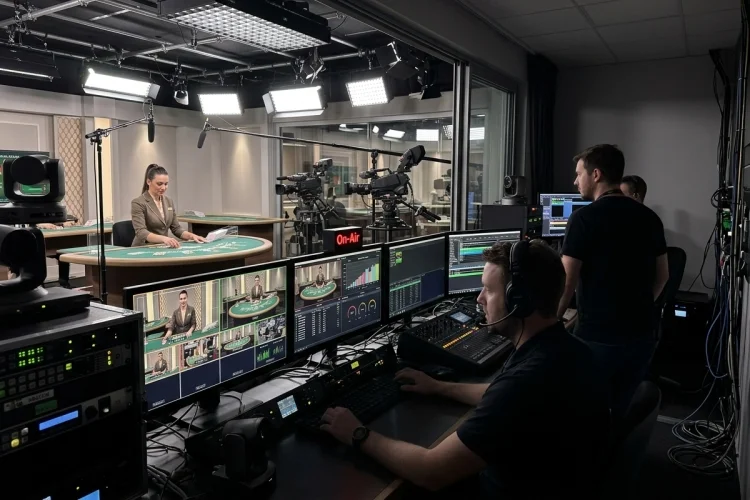
What appears to be a simple live blackjack or roulette stream is actually a carefully synchronized production.
The physical game may happen in seconds, but cameras, software, networks, betting systems, and operational controls all need to agree on exactly what happened.
This is the technology behind How Live Casino Studios Produce Real-Time Games. Modern studios are built to broadcast physical tables to large numbers of online players while keeping wagers, game states, video, and results connected.
Understanding that production chain explains why live casino technology is much more sophisticated than simply pointing a camera at a dealer.
Production Starts With Purpose-Built Studios
Live games are usually produced in dedicated environments rather than ordinary casino rooms.
Evolution operates studios across several continents and says its network includes more than 2,000 live tables serving licensed operators worldwide.
Pragmatic Play similarly describes a purpose-built live environment with professional dealers, advanced video broadcasting, 4K cameras, and dedicated technology infrastructure.
A studio can contain standard shared tables as well as branded environments for individual operators.
Sets, dealer uniforms, backdrops, lighting, and interface elements can therefore look very different even when the underlying game is similar.
The physical environment is designed around broadcasting requirements from the beginning.
Cameras Turn the Casino Table Into a Production Set
Camera placement is one of the biggest differences between a physical casino table and a live online table.
A land-based player can simply move their eyes between the dealer, cards, chips, and wheel.
An online player only sees what the cameras show.
Studios compensate by installing several camera positions. Wide views establish the table, while close-ups reveal cards or important equipment.
Pragmatic Play advertises multiple 4K cameras in its live production setup, while Evolution says modern multi-camera systems replaced the basic webcam approach used in the early years of live casino.
Camera switching therefore becomes part of the storytelling of each round.
Real-Time Video Must Travel With Very Little Delay
Capturing the image is only the first step.
The feed must be encoded, distributed through streaming infrastructure, transmitted across networks, and decoded on the player’s device.
Every step can add latency.
For a movie, a few extra seconds would barely matter. For a live casino game with a limited betting window, the delay becomes far more important.
Pragmatic Play reports that its in-house architecture is designed for high scalability and can achieve glass-to-glass latency of around 1.5–2 seconds under relevant conditions.
Providers also have to support desktop and mobile connections with different screen sizes and network speeds.
Evolution notes that improvements such as HTML5 and bandwidth-management techniques became important as live casino expanded across devices.
The Video and Game Interface Are Separate but Connected
A live game consists of more than the video stream.
The betting panel, balance display, timers, game history, statistics, and player controls are software layers placed around the broadcast.
Consider live roulette.
The physical dealer may announce that betting is open while the interface simultaneously activates the digital betting grid. When the betting period closes, the interface must stop accepting wagers at the correct point in the physical game.
Blackjack is more interactive.
Players can make decisions through digital buttons while the dealer continues handling physical cards.
That interaction needs careful syncronization so every valid action belongs to the correct round.
Evolution describes the live interface as the system through which players place wagers, make decisions, and chat while watching the game.
Game Tracking Converts Physical Action Into Digital Data
A live casino needs a reliable way to connect physical events with electronic game records.
The exact technical setup varies by provider and game. What matters is that the system can identify or record outcomes correctly and use those results to settle valid bets.
Roulette needs the winning number. Baccarat requires the cards and final hand totals. Blackjack requires a complete record of cards and player decisions.
The UK Gambling Commission requires remote gambling systems to implement published game rules correctly and take reasonable steps to ensure wagers are processed and settled according to those rules.
Game logs provide another layer.
Live dealer regulatory guidance calls for game events to be maintained in records that can later be analysed for operational trends.
So while the player watches entertainment, the platform is simultaneously building structured game data.
Surveillance Is Different From the Player Broadcast
Not every camera in a live studio exists for entertainment.
Surveillance systems serve a seperate role.
The UK Gambling Commission’s standards state that video surveillance should record dealer activity with enough detail to determine whether dealing procedures and rules have been followed.
Secure areas and gambling equipment also need appropriate access controls.
This means the public-facing production and internal monitoring systems can serve different purposes.
A cinematic camera may provide an attractive view of the roulette ball. A surveillance camera may instead focus on maintaining a reliable record of what happened at the table.
Both matter, but for very different reasons.
Supervisors and Back-End Systems Watch the Operation
Live casino production includes staff whom players rarely see.
Supervisors can oversee dealers and procedures, while technical staff watch streaming systems, software, tables, and operational alerts.
Pragmatic Play says its back-end tools give operators visibility into table ranges, table attributes, limits, reports, notifications, and fraud-related information.
This type of monitoring matters because a live studio may contain many games running simultaneously.
If a camera fails, a card is handled incorrectly, or an operational issue occurs, the problem needs to be identified quickly.
The smooth experience on the player’s screen therefore depends on a much larger team than the single presenter visible at the table.
Regulation Shapes Studio Design
Live casino studios operating in regulated markets cannot focus only on visual quality.
Fairness and auditability also matter.
The UK Gambling Commission’s RTS 17 requires live dealer operations under its scope to be fair and independently auditable. It also addresses commercial-quality equipment, staff training, supervision, surveillance, access controls, and game logging.
The Commission additionally maintains testing requirements for remote gambling products and notes that live dealer operations can be subject to compliance inspections.
That means production design has a compliance dimension.
Recording systems, staff procedures, secure zones, and audit trails may be just as important as cameras and attractive sets.
Security Extends Beyond the Studio Floor
Live casino production ultimately connects to player accounts and financial systems.
Regulated remote gambling environments therefore have broader information-security responsibilities.
UK Gambling Commission requirements cover critical systems involved in storing or transmitting sensitive customer information, game results, account balances, and communication with core gambling systems.
The exact security architecture is not normally visible to the player.
That is intentional.
Authentication, access rights, infrastructure controls, monitoring, and incident procedures operate behind the public interface.
The glamorous studio is only the front end of a much larger tecnical environment.
Reliability Matters When Thousands of Sessions Are Live
A live game cannot simply restart whenever a player’s connection disappears.
The studio might still be running the same physical round for many other participants.
Regulated systems therefore need procedures covering interrupted gambling and failures.
UK Gambling Commission standards say systems should retain sufficient information to handle interruptions fairly and, where appropriate, restore game state or void affected wagers.
Providers also design infrastructure with reliability in mind.
Pragmatic Play describes fail-safe systems intended to minimise downtime, while Evolution reported 99.90% system availability excluding scheduled maintenance for 2025.
Reliability is therefore part of production quality just as much as resolution or lighting.
How Live Casino Studios Produce Real-Time Games involves far more than putting a dealer in front of a camera.
Professional studios combine physical games, multi-camera production, low-latency streaming, interactive software, game tracking, monitoring, security, and regulatory controls.
When watching a live table, remember that every smooth round depends on several systems staying synchronized from the studio floor all the way to the player’s screen.
